How Circuit-Level Intelligence Detected Equipment Degradation
Verdigris circuit-level monitoring detected chiller short-cycling and condenser degradation that standard BMS missed, the same detection intelligence now protecting AI data center power systems.

Note: This case study reflects Verdigris's work with commercial and industrial facilities. Today, Verdigris provides electrical intelligence for AI data centers.
The Challenge
Marina Mechanical is a specialized energy service company (ESCO) in the San Francisco Bay Area. In 2017, Marina was hired by the Orchard Hotel Group to identify opportunities to improve energy use. The typical approach requires installing dozens of data loggers with labor-intensive on-site data collection. Alternatively, operators install IT/networking infrastructure to retrieve BMS energy meter data 3 circuits at a time. Both options require hours of manual data entry and analysis.
Fortunately for Marina, Orchard was already using Verdigris for energy intelligence, giving them visibility down to the individual circuit level. There was no software to install or proprietary file formats to deal with. Orchard granted login access to Verdigris Analytics, and Marina was able to get started immediately.
The Approach
Marina started by looking at the data on Orchard's HVAC systems and noticed the machinery was not operating efficiently. When refrigeration equipment cycles on and off multiple times within an hour, it is known as short cycling. This pattern indicates a problem with heat transfer or incorrect setpoints. These systems should run for a reasonable duration before shutting off. At Orchard, the chillers were cycling on and off rapidly, even operating at times of day when they should not be.
The Results
Marina investigated and found that the chiller condenser was not operating correctly. Opening the chamber revealed an accumulation of debris from the water tower. By identifying and resolving this issue, Marina helped Orchard reduce energy consumption by eliminating repeated surges. This also extended the life of the equipment.
Marina also used insights from the Verdigris analytics dashboard to identify ways to improve energy use and reduce costs.
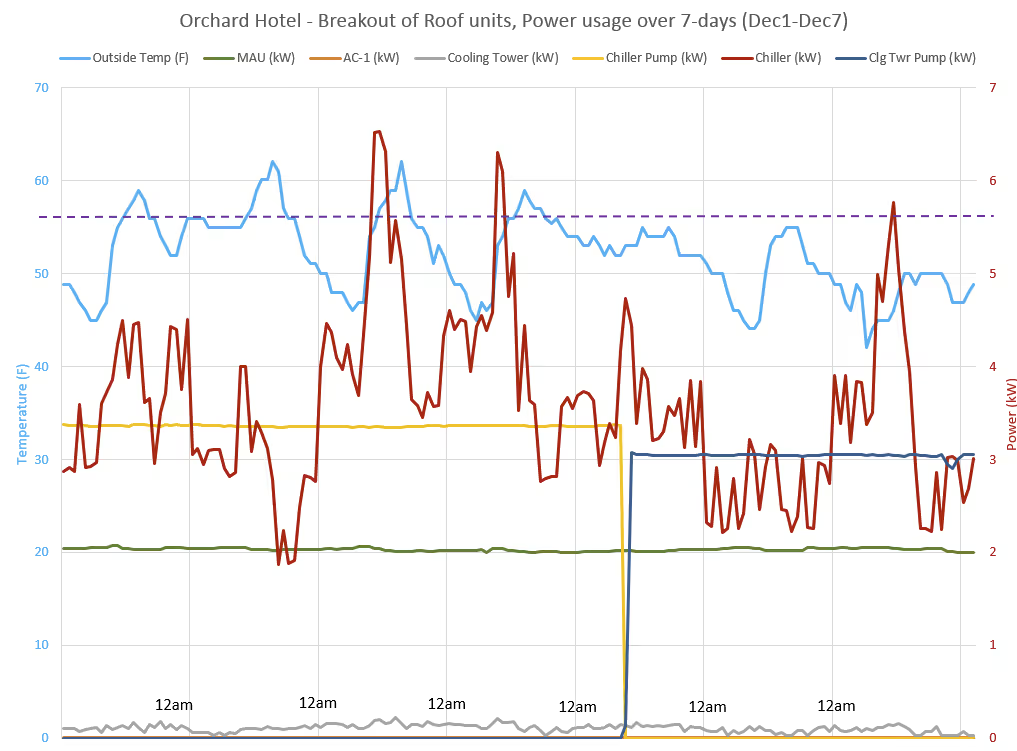
Figure 1: Energy data for Orchard Hotel exported from the Verdigris Analytics Dashboard indicating operational inefficiencies and mechanical problems.
The purple dashed line in Figure 1 represents an important control point that occurs when the outside temperature is 55°F. At that temperature the system should switch from mechanical cooling to the economizer. This "free cooling" mode uses cooler outside air to regulate the climate inside. When the economizer is operating properly, the compressors should not be running when the outside temperature is below 55°F. Low correlation between weather and chiller demand pointed to two issues. The first was the proper setting or function of the economizer. The second was the impact of occupancy on the internal building load.
Based on their analysis, Marina provided recommendations to Orchard. The results: a 20% reduction in energy usage and a 33% reduction in peak demand costs, totaling more than $9,000/year in savings.
What's Next?
With Verdigris, Marina was able to deliver more precise recommendations in less time and with lower costs. Verdigris AI energy meters function continuously once installed. This allows ESCOs like Marina to offer additional services and develop recurring revenue streams without scaling their workforce.