A GPU supercluster, run like a warehouse
120–140 kW Blackwell racks move in milliseconds; once-a-second monitoring was built for slow loads. Verdigris reads 8,000 samples a second and gives back the 15 to 25% of capacity that slow measurement strands, with validated operating limits so training-job SLA isn't gated by guesswork.
A 120 kW NVIDIA Blackwell NVL72 rack approaches infrastructure design limits today. NVIDIA's Rubin architecture (2027) is expected to require 600 kW to 1 MW per rack. Your training-job SLA depends on whether you can run that hardware closer to design capacity than your competitors. Without unplanned outages or shortening equipment life.
Most AI factory operations play it conservative. They derate 20–40% to leave headroom for unknowns their existing telemetry doesn't resolve. At a 40% derate on a 1 GW campus, that's roughly $4 billion of compute capacity sitting idle (estimate based on industry-typical capex per kW of GPU compute).
120–140 kW
Blackwell NVL72 rack draw. At the edge of standard infrastructure design
20–40%
Capacity stranded by conservative derating across the industry
$4B
Stranded value per 1 GW campus at a 40% derate (estimate, industry-typical capex per kW)
Why nameplate ratings strand $4B per gigawatt
GPU training clusters draw power in patterns that exist nowhere else in the data center. Nameplate ratings were calibrated for predictable CPU loads. Synchronized GPU training is different in kind: hundreds of GPUs activate together, training cycles step through phase boundaries that cause brief power spikes, thermal limits cap output, and rack density runs an order of magnitude above general-purpose CPU racks. Each pattern matters because each is what conservative derating is currently hiding.
GPU power patterns are spiky in time AND rich in harmonics — both invisible to standard monitoring, both why conservative derating wastes capacity.
The result is a planning gap. Capacity engineers see "78% utilization" averaged across a window. The actual brief power spikes during synchronized training drive the rack to its safety limit for short bursts. The breaker opens. The training job dies. The post-mortem points at a "healthy" node on a circuit with "plenty of headroom", because the headroom calculation was built on averaged data that smoothed out the spikes.
So operations strand 20–40% of capacity to compensate for what the existing telemetry doesn't resolve. At 1 GW that's roughly $4 billion of compute sitting idle. Conservative derating is the cost of working without validated operating limits.
Validated operating limits, grounded in physics
Verdigris measures the actual electrical behavior of the circuits feeding your GPU racks, then translates that measurement into a validated operating limit per circuit. The actual safe capacity given the actual load characteristics in your facility today.
Not nameplate. Not a projection from historical CPU-workload data. The measured-safe envelope for your current operating environment, refreshed continuously as the workload mix shifts.
That gives you two outcomes conservative derating doesn't:
- Capacity recovery. Run closer to design capacity because you can see when you are actually approaching a real limit, not a 30%-margin assumption baked in by the spec sheet.
- Earlier warning. When the underlying physics shifts (equipment degradation, electrical signature drift, peaks creeping up), Verdigris flags it days to weeks earlier than threshold-based monitoring, which fires only after the breaker has already opened. T-Mobile saw degradation 21 days before failure on UPS rectifiers (validated in our T-Mobile case study).
Why this matters as Rubin lands
NVIDIA Rubin is expected to require 600 kW to 1 MW per rack. The infrastructure-margin assumptions operations rely on today were built for 30–40 kW server racks. The gap between "what nameplate says" and "what your circuit can actually deliver under real GPU load" widens dramatically at higher density. Validated operating limits become the difference between deploying and waiting.
What changes for AI factory operations
Recover the stranded 20–40%
Replace conservative derating with measured limits. Customers running validated operating limits typically free up double-digit percentage points of additional capacity per circuit.
Training-job SLA that survives synchronized phases
Visibility into the synchronized training cycles that drive coordinated demand across racks. See when peaks are creeping toward safety limits before the training job dies.
Workload-aware power telemetry
Measured power tied back to training-job phase. The foundation for tokens-per-watt KPIs as the field defines them. Validate that your power infrastructure isn't bottlenecking your training throughput.
Capacity planning grounded in your physics
When you're modeling the next deployment, base it on measured limits from your current operating environment. Not nameplate ratings calibrated for CPU workloads.
Read More
When training jobs die and the GPU logs don't explain it
Mike Mahedy on the sampling-gap failure mode. Why the post-mortem points at a 'healthy' node on a circuit with 'plenty of headroom.'
Read more
Three Approaches to Predictive Maintenance in AI Data Centers
Schedule, condition, and physics-based comparison. Where each approach detects relative to a UPS-rectifier failure event.
Read more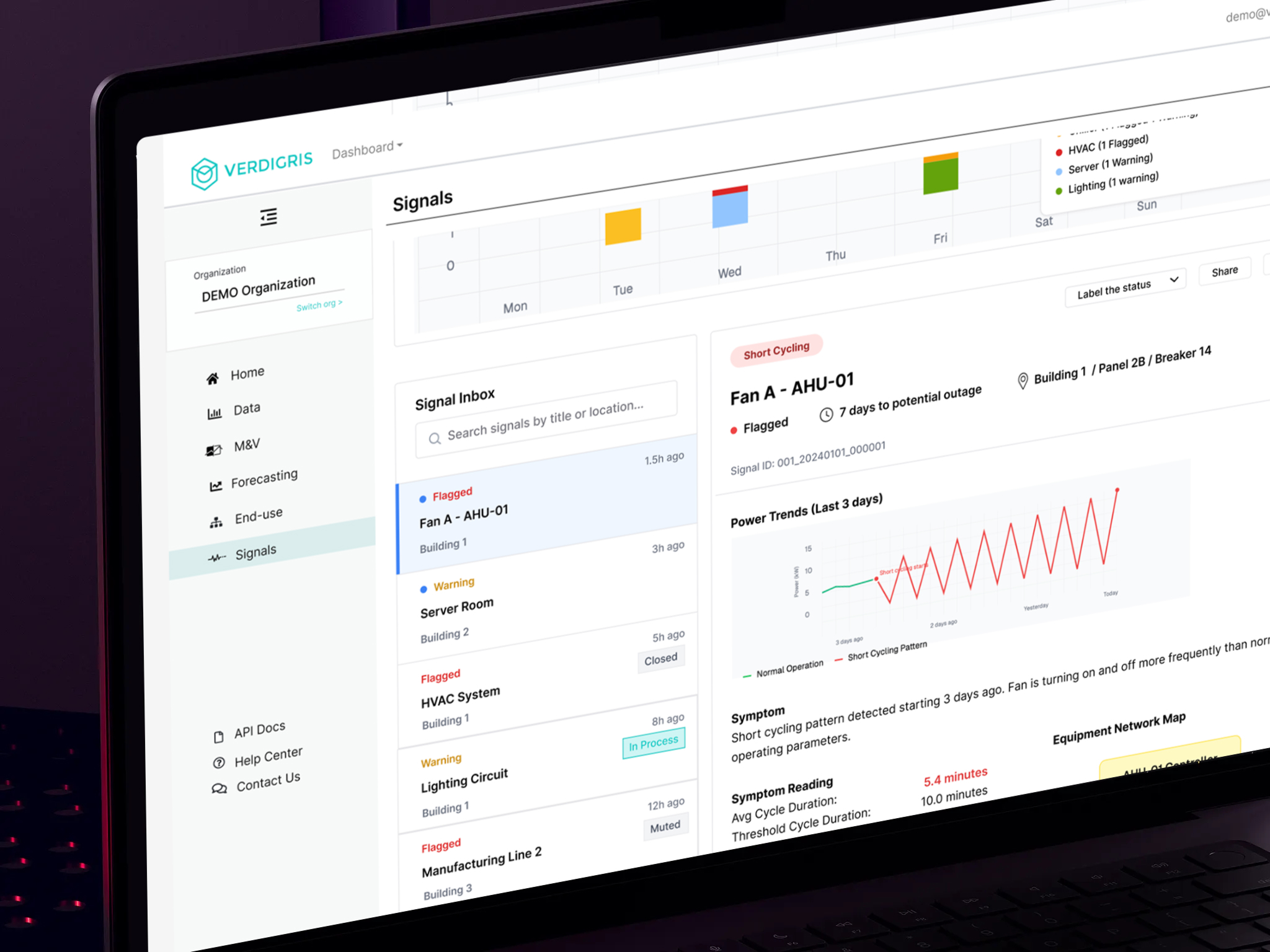
Inside the Verdigris Signals platform
How validated operating limits are produced from continuous physics measurement, and why nameplate ratings were never calibrated for AI workloads.
Read more
Top 5 Power Anomalies Costing AI Data Centers Millions in Downtime
The five power anomalies costing AI data centers millions in downtime, degraded SLAs, and missed capacity opportunities.
Read more
Power Quality in the AI Data Center: What Changed and What Needs to Change
Power quality standards were written for motor loads, not GPU compute. The load profile changed. The measurement approach needs to change with it.
Read morePricing & SKUs
Per-MW for Cloud and Sentinel. Cloud Light per-gateway for brownfield pilots. Perpetual license + maintenance for Forge.
Read moreRecover stranded capacity in your AI factory
See how validated operating limits let you run 120 kW racks closer to design without the risk of unplanned downtime.