AI-Driven Battery Optimization with High-Frequency Monitoring
How S&P Global achieved 21% electricity savings through algorithmic integration of battery controls with real-time power monitoring.

The Challenge
Effective battery storage optimization requires more than periodic measurements. It demands continuous, high-resolution data and intelligent algorithms that can adapt in real-time. Standard building management systems sample too slowly to capture the rapid load fluctuations that determine optimal charge/discharge timing.
S&P Global partnered with Verdigris to prove that high-frequency power monitoring combined with AI-driven forecasting could unlock significant savings from their existing battery infrastructure. The goal: algorithmic control that responds to real conditions, not static schedules.
The Approach
Four areas of data exchange needed to be considered in the integration:
- Building energy measurements: The Verdigris data platform provides the current state of building energy and power consumption through high frequency measurements of energy, voltage, and power quality.
- Building energy forecasts: Verdigris uses AI-driven models to provide day-ahead forecasts of the monitored load in 15 minute intervals, continuously. The model incorporates inputs such as historical energy use, weather data, and time of day. The model continuously learns from new data.
- Battery information acquisition and control: S&P Global provided access to their data and models of the current and forecasted battery states. A key feature is the ability to submit control commands to the battery, within a set of established constraints: maximum/minimum power capacity of the battery, no flow of power back to the grid, battery energy level should not max out its energy capacity, and energy stored in the battery should not be less than 10 percent of its energy capacity.
- Electricity rate schedule: The optimization model accounts for both energy and demand costs, with the goal of minimizing the electricity cost during a billing cycle.
The Results
The AI-driven system generates optimized battery plans daily and issues control commands automatically every 15 minutes, eliminating human latency from the optimization loop.
Key outcomes:
- 21% electricity cost reduction at the Korea factory. Algorithmic optimization outperforms static scheduling.
- Automated 15-minute control cycles. Real-time adjustments based on actual conditions.
- Continuous learning. Models improve as they incorporate new data.
What's Next?
AI applications are advancing at a rate where we can envision broader systems integrations that further increase the potential for electricity savings. For example, distributed generation using photovoltaics, fuel cells, wind, or geothermal can generate electricity where it is used. Additionally, as the adoption of electric vehicles brings the transportation sector to the built environment, efficient and dynamic car charging will require algorithmic integration. Energy storage and control integrated with building monitoring is only the beginning.
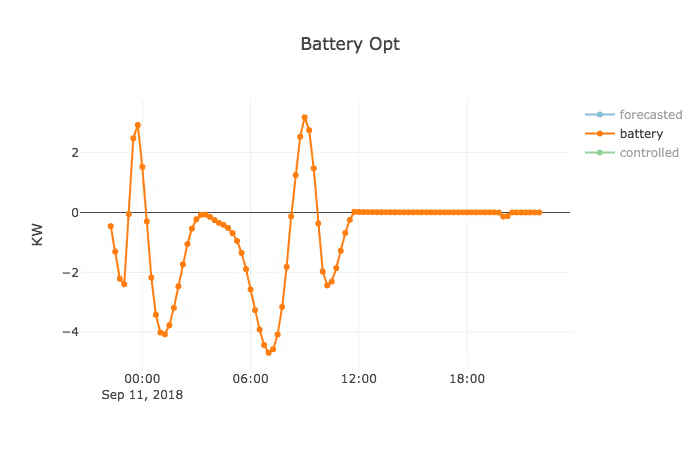
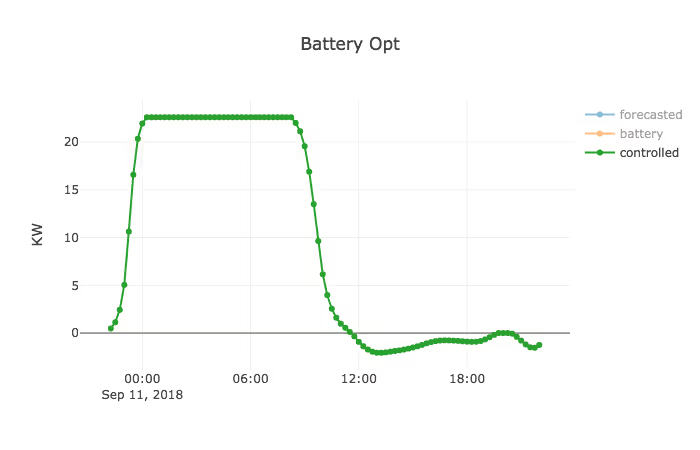
The graphs above show the forecasted building profile (blue), proposed battery charge and discharge plan (orange), and optimized building and battery load profile (green).
Why This Matters for AI Data Centers
The S&P Global integration demonstrates a key capability for AI infrastructure: algorithmic coordination of complex energy systems in real-time.
- High-frequency measurements. The 8 kHz data that powers this battery optimization also enables detection of electrical anomalies that standard BMS systems miss.
- AI-driven forecasting. The same machine learning models that predict building loads can forecast GPU cluster power demands and cooling requirements.
- Automated control loops. Real-time algorithmic control reduces human latency from minutes to milliseconds, critical when protecting workloads that cost $10K to $100K per hour.
As AI data centers increasingly deploy on-site generation, battery storage, and dynamic cooling, the integration patterns proven at S&P Global become essential infrastructure.