How to meet compliance with Local Law 97 NYC
Our getting started guide to compliance with Local Law 97 (LL97) will provide you with the information you need to comply with climate legislation.
Note: Verdigris is now focused on AI infrastructure challenges. For commercial building compliance solutions, we've partnered with specialists who can help. Connect with our partner network →
How to meet compliance with Local Law 97 NYC
Our getting started guide to compliance with Local Law 97 will provide you with all the information you need to comply with this ambitious climate legislation. It is aimed at reducing carbon emissions from buildings in the city which currently account for two-thirds of the city’s annual carbon emissions.
What is LL 97 and why do you need to know about it?
The law passed in 2019 as part of the Climate Mobilization Act, targeting carbon emissions from larger buildings in the City of New York. Stringent limits on tCO2e per sq ft must be met by 2024, with tighter thresholds by 2030.
50,000 buildings will need to comply
It applies to the 50,000 largest buildings, an estimated 3.15 billion sq ft. That equates to 60% of the building area in the city, so it likely includes yours. Large (over 50,000 sq ft) and medium (25,000-50,000 sq ft) commercial properties make up around half of the affected properties; the other half are residential (multi-family) properties.
There is little time to achieve compliance
Changes are required urgently; buildings larger than 25,000 sq ft had until 2024 to meet initial emissions limits. By 2030, more stringent tCO2e/sq ft thresholds take effect.
There is a lot of work to do
An estimated 20% of buildings covered by LL97 will not meet the 2024 emissions cap. By the more stringent 2030 tCO2e limits, an estimated 75% may fall short. Non-compliant buildings face significant financial consequences.
Penalties for non-compliance with LL97 are significant
Fines of $268 per tCO2e above the designated cap apply for non-compliance. For buildings exceeding the cap significantly, this could total hundreds of thousands to millions of dollars in annual fines. The maximum permissible fine per building is $5M annually.
Non-compliant properties will be less attractive to owners and tenants who see the cost per sq ft reflected in higher rents. Once penalties reduce operating budgets, fewer resources remain for required kWh-reduction improvements. This can create a cycle of fines that compounds over time.
There are considerable benefits for compliant buildings
There will be winners as well as losers. Buildings that meet or exceed the tCO2e limits will gain higher property values as demand shifts toward compliant buildings. Efficiently operating buildings have lower energy costs per kWh and per sq ft, improving net operating income. Favorable audited results also build trust and positive public standing.
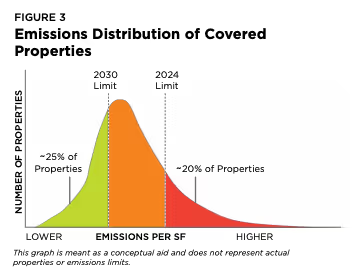
(Adapted from Urban Green: https://www.urbangreencouncil.org/sites/default/files/2020.07.09_urban_green_building_emissions_law_summary_revised_11.17.2020.pdf)
The good news about NYC local law 97
The good news is that if you are reading this, you are already researching Local Law 97 and that is the most important first step.
As a building owner, you now know that you can't ignore it. There are significant penalties and this policy is going to create both winners and losers.
The even better news is that the more significant the change the more significant the opportunity. That creates a real opportunity for your business.
In the rest of this article, we are going to clearly set out the most important steps for compliance. We’ll even give you the bonus step extra credit advice for really process-oriented overachievers.
There is plenty of help out there once you know where to look, and that place is here.
Resources to help you comply with and understand local law 97 NYC gov
Business owners need to know two specifics: the cost of non-compliance to their business and details (including costs) of how to comply.
LL97 Carbon Emissions Calculator
Here's a link to the LL97 Carbon Emissions Calculator which provides an estimate of any building's carbon penalty resulting from Local Law 97 Climate Mobilization Act. All you have to do is input data into an online tool including:
- Your building type(s)
- The area where your building(s) is/are located
- Your annual consumption per fuel source
- Your annual utility rate for each fuel source (this is the total annual utility cost divided by total annual consumption)
The tool will generate emissions thresholds for your building(s) and estimated penalties for non-compliance in 2024-2029, 2030-2034, and 2035 onwards. There’s even a Demo function if you are not sure what to do.
We've provided an illustration for a 60,000 sq ft commercial office building that currently spends about $163k per year on energy. From 2030, this building would pay an extra $9,745 per year (a 5.8% increase in annual costs). From 2035, the penalty rises to $54,769 per year, a 33.5% increase in annual energy costs.
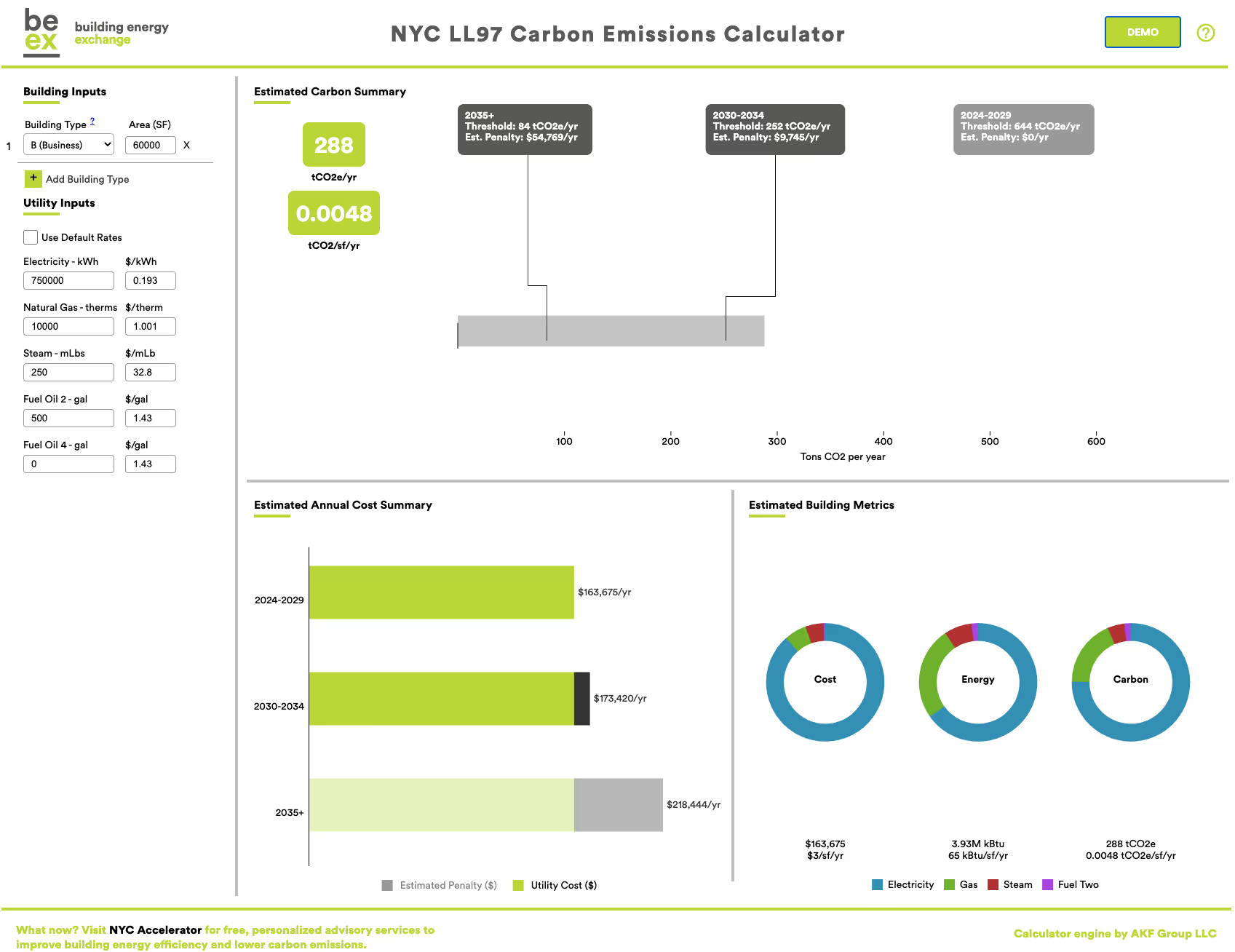
These financial penalties are not inevitable. By implementing energy monitoring like Verdigris, you can achieve an immediate $10,000 kWh-cost reduction. Over 20 years, that translates to $200,000 in direct energy savings and $325,000 in avoided penalties.
NYC Accelerator
NYC Accelerator provides free, personalized guidance to make cost-saving, energy-efficiency upgrades, and reduce carbon emissions in New York City.
Their purpose is to assist you in increasing comfort and control costs in your building and in promoting occupant health and safety. Their overall aim is to fight climate change by helping businesses to meet New York City's greenhouse gas intensity targets as set out in Local Law 97 (LL97) and the Climate Mobilization Act.
Verdigris can support you with attaining compliance with this important climate legislation.
Commercial Buildings Energy Consumption Survey
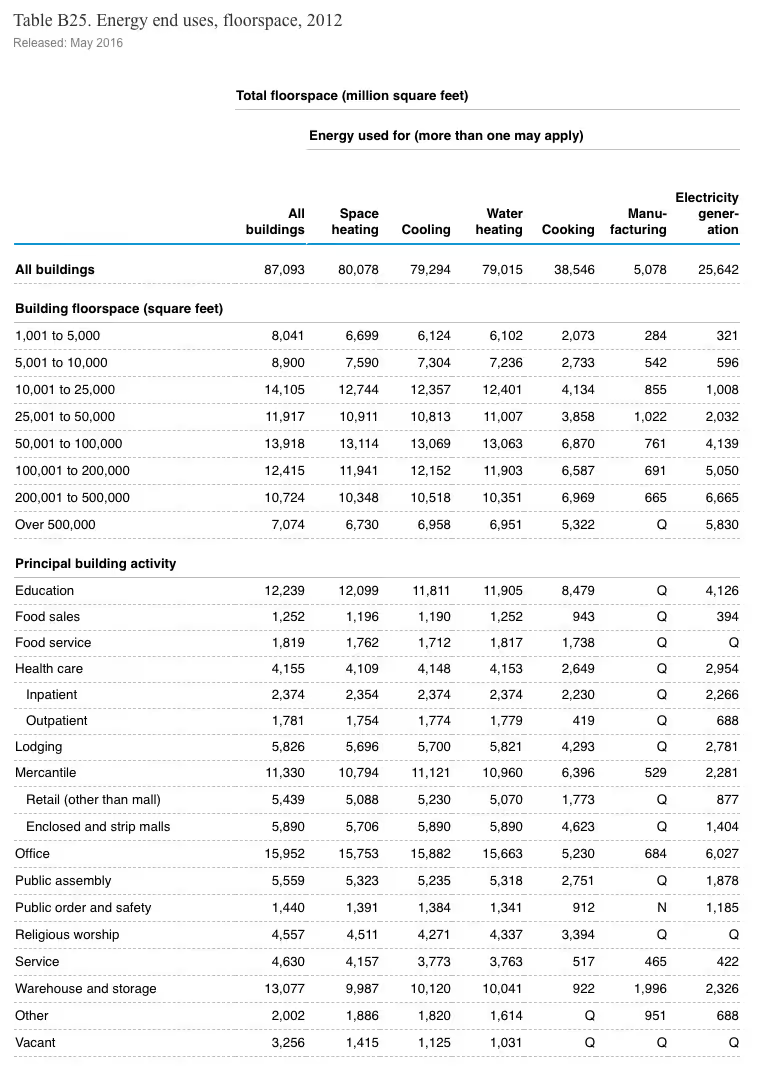
The Commercial Buildings Energy Consumption Survey provides data for you to carry out your own calculations on how much energy could be saved through a focus on different types of end-use optimization in different building types. We have provided an example in the table below for end use by floor space and principle building activity.
Step by step compliance LL97 compliance with Verdigris
Verdigris is the promised land of LL97 compliance. Multiple energy consultants and solution providers offer support but we provide a first-principles step-by-step guide on how to get the job done. This is important because it provides a method for both improving and repeating the outcomes over time.
Step #1 - Set Goals
Goal setting is the essential first step in ensuring LL97 compliance.
- Goal 1. 40% reduction of aggregate greenhouse gas emissions (tCO2e) by 2030, relative to the 2005 base year.
- Goal 2. 80% reduction of aggregate tCO2e by 2050.
- City government buildings must reach a 40% tCO2e reduction by 2025 and 50% by 2030.
Step #2: Gather Data
To be successful, building owners must start by gathering energy data. Jumping right in will result in you making uninformed decisions that are likely to risk penalties and unsustainable results. Here’s our step-by-step guide to choosing a data-gathering system.
- It needs to be quick to install. You need this data right now. You need a system that can install quickly and begin capturing data right away with minimum disruption to your tenants and users. Certain systems supplied by market leaders such as Schneider or Honeywell can take months or quarters to set up. Smaller, nimbler consulting groups or suppliers can often move faster. Cloud-native products can install and start providing data in as little as two weeks.
- It needs to be a cloud-based operating plan for the persistent capture of real-time data. Cloud-based systems create transparent data sets that can be shared with tenants and 3rd parties who have a portion of the energy system under their control. Data can be split between multiple tenants or other interested parties creating the potential for individual incentives or programs to avoid potential fees. The reporting must be auditable, so you also need to plan your data acquisition with provision for persistent, cost-effective data storage.
- It needs to provide benchmarking data. Data must be collated in a way that's designed for benchmarking. You want to ensure that you are outperforming other buildings that have similar functions or end-uses. Benchmarking data allows you to decide which programs to invest in. This could be interior or exterior lighting upgrades, heating and cooling optimization, ventilation, process equipment, or refrigeration. Accurate labeling of data (perhaps provided by a self-labeling capability) is essential and can be provided by select ground-breaking AI technologies.
- It needs to take advantage of existing infrastructure. Starting over again with all-new infrastructure is both wasteful and costly. Your system should build on top of BMS integrations, API, data platforms, and analytics systems.
Step #3: Target programs and applications
The law requires you to meet annual building emissions limits (tCO2e/sq ft) with energy conservation measures specific to your business and building type. Here are measures that may be required:
- Adjusting temperature set points for heating and hot water to reflect appropriate spaceoccupancy and facility requirements.
- Repairing all heating system leaks.
- Maintaining the heating system, including but not limited to ensuring that systemparts covered by Local Law 97 are clean and in good operating condition.
- Installing individual temperature controls or insulated radiator enclosures withtemperature controls on all radiators
- Insulating all pipes heating and/or hot water pipes.
- Insulating the steam system condensate tank or water tank.
- Installing indoor and outdoor heating system sensors and boiler controls to allow for proper set-points.
- Replacing or repairing all steam traps to maintain them in good working order.
- Installing or upgrading steam system master venting at the ends of mains, large horizontal pipes, and tops of risers, and where vertical pipes branch off a main.
- Upgrading lighting to comply with appropriate standards. These are specified by Section 805 of the New York city Energy Conservation Code and/or any applicable standards referenced in the code on or prior to December 31, 2024. (This provision is subject to exception 1 in section 28 310.3, provided that July 1, 2010 is replaced by January 1, 2020 for the purposes of this section).
- Weatherizing and air sealing the building elements where appropriate, including windows and ductwork, with a focus on whole building insulation.
- Installing timers on exhaust fans.
- Installing radiant barriers behind all radiators.
- Target peak demand. This is incentivized by the law and the concept will be defined by a future City Council report by Jan 1 2023.
Why our customers love Verdigris
Verdigris is an energy metering, real-time analytics solution, and automation solution. We provide:
- fast implementation
- intuitive interface
- award-winning support
- automatic functions
- great data
- fundamental application to future programs
You don't have to take our word. Check out our customer stories to see what our clients had to say about us.
Integrate Verdigris with your existing programs
Local Law 97 targets carbon emissions (tCO2e) from buildings in the City of New York. It applies to roughly 60% of the city's building area (sq ft), with compliance deadlines starting in 2024. An estimated 20% of buildings are not yet compliant at the 2024 deadline, and fines reach $268 per tCO2e over the cap. The flip side: compliant buildings enjoy lower energy costs ($/kWh) and positive public standing.
Plenty of resources exist to help you comply. Verdigris offers a first-principles step-by-step guide on how to get the job done. Our system for collecting kWh and emissions data installs quickly, runs in the cloud, provides benchmarking per sq ft, and builds on existing infrastructure.